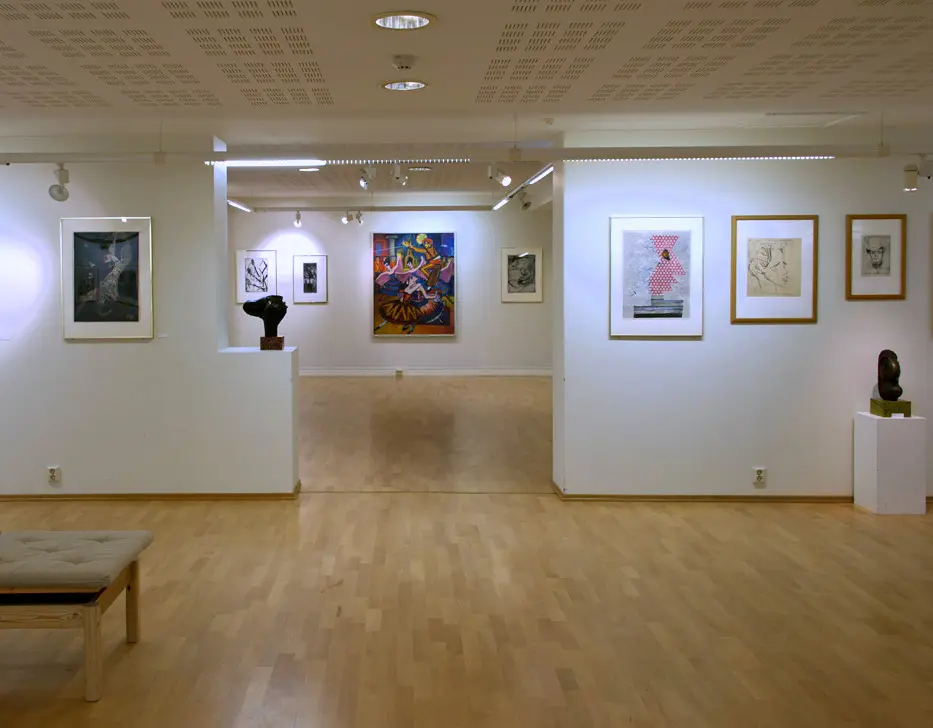
An international artistry in Hallingdal
Rolf Nesch was born in Germany in 1893 and trained at the art academy in Dresden. Following political unrest in Europe, he moved to Norway in 1933, and a few years later he settled in Hallingdal.
Here he found inspiration in nature, light and materials, and developed a design language that combined technical craftsmanship with experimental innovation.
Nesch is considered one of the most innovative artists in the Nordic region in the 20th century. He broke away from the traditional forms of printmaking and painting, searching for a way to give his images depth, structure and physical presence.
The Nesch Museum offers a unique insight into his entire artistic development, from his early etchings to the tactile metal prints and three-dimensional material images that made him internationally famous.
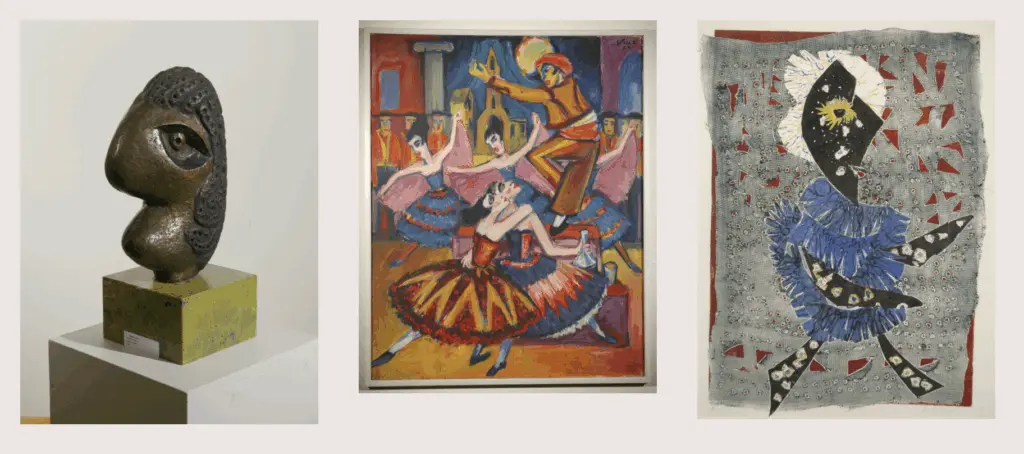
Techniques and expressions you can experience
A visit to the Nesch Museum gives you not only an artistic experience, but also the opportunity to see how Rolf Nesch challenged the materials he worked with. As you walk through the exhibition, you can see the differences between the various techniques.
1. Etching and etching
Nesch started out as a printmaker and used the techniques of etching and engraving, where metal plates are used as printing moulds, or as a kind of stamp with far more precision and depth.
- I erasure the artist scratches the motif into a metal plate with a pointed needle. The colour is placed in the grooves and the plate is pressed against the paper so that the lines are transferred.
- I etching the disc is first covered with a thin layer of wax. The artist scratches the motif through the wax and then places the disc in an acid bath that etches the lines into the metal.
Nesch accidentally left a disc in the acid for too long. Holes appeared in the printing plate, and when he pressed the plate, the areas with holes turned completely white. He consciously utilised this discovery and it became an important part of his expression.
Metal printing
Eventually, Nesch wanted to give the prints more life and depth. He began to solder mesh, wire and thin metal plates directly onto the printing plate, giving the surface different heights and textures. When the plate was printed on paper, the textures left clear traces in the surface. This gave the image a sense of depth and movement, as if the subject was alive on the paper.
He also experimented with colours. Instead of using one plate for each colour, he placed several colours directly on the same plate.
When the plate was printed, the colours mixed in unpredictable ways, giving each print its own unique expression.
This technique, now known as metal printing, added a new dimension to Nesch's images, where light, colour and texture interacted in a vibrant way.
Material images
Through his work with metal printing, Nesch realised that the printing plates themselves had their own visual value. He began to build images directly in materials such as metal, glass, rope and cork,
In these works, the materials are not just part of the motif, they are the motif. The result is images that approach sculpture, where light and texture play the main role.
Experience art with new eyes
A visit to the Nesch Museum in Ål allows you to follow an artist's journey from precise lines to living structures and free-form materials.
See how Rolf Nesch turned chance into artistic discovery, and how curiosity, experimentation and the courage to make mistakes made him a pioneer of modern printmaking.
Practical info
Opening hours 2025
11:00 - 16:00 Mon - Tue
11:00 - 20:00 Wed - Fri
15:30 - 20:00 Sat
16:30 - 20:00 Sun
Prices
Adult: kr. 70,-
Children (0-16 years): Free of charge
Groups (min. 10 pers.): DKK 50,-
Address
Myren 40, 3570 Ål